
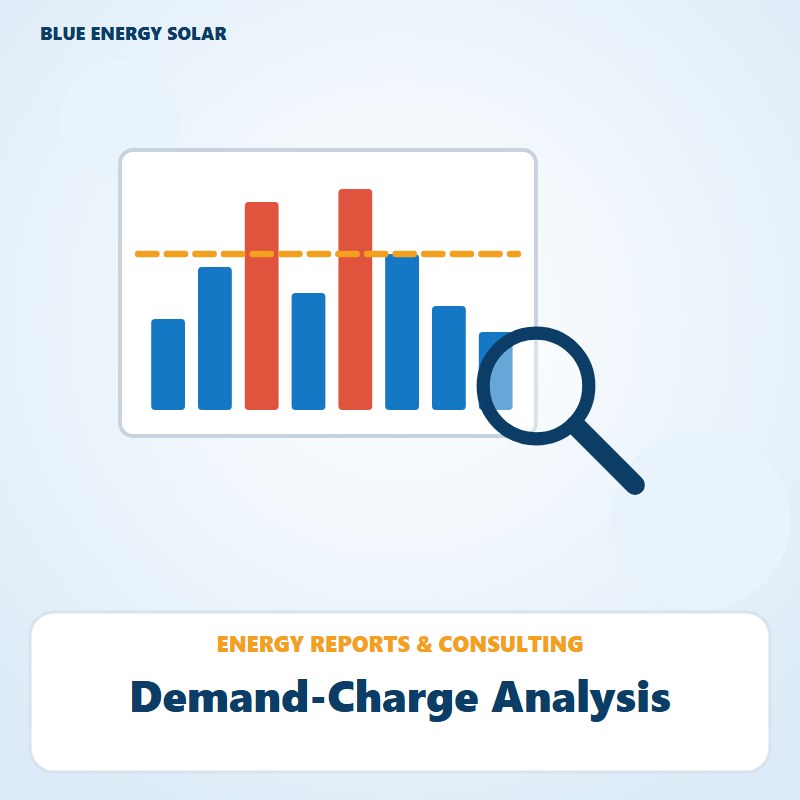
Find out exactly which half-hours set your demand charge and what a battery, load shifting or power factor correction could realistically save your business.
From $690 (Per site), including GST. Indicative starting price: the final fixed price is confirmed in writing after a site assessment.
On many commercial tariffs, a single busy half-hour can set the demand charge for a whole month, and on some tariffs for longer. Because the charge is based on the highest rate of draw rather than total energy, businesses often pay heavily for a few short peaks they do not know about. Our Demand-Charge Analysis finds those peaks, explains what caused them and tests which options would reduce them.
The analysis is priced from $690 per site as an indicative starting price, confirmed in writing once we have seen your tariff and data.
Demand charges can be a significant share of a commercial bill, yet many businesses cannot say when their peak occurred last quarter. We design commercial solar and batteries to target that peak, not just total usage, so we understand which options tend to work in practice and which only look good on paper. Some peaks are best solved with no hardware at all, and when that is the case, the report says so plainly.
Commercial sites on a demand tariff whose demand charges are a large or unpredictable part of the electricity bill.
Solar alone often does little for demand charges when peaks occur early in the morning, late in the afternoon or on cloudy days. A battery can reduce peaks, but only if it is large enough and controlled to discharge at the right time. Power factor correction only helps where the demand charge is measured in kVA and the power factor is poor.
From 1 September 2026, eligible NSW business batteries from 20 kWh may attract state incentives. We note where this could apply, and you should confirm current values on the official NSW page before signing. Savings estimates depend on how the site operates and on future tariffs.
1. Request the analysis and send us recent bills and 12 months of interval data.
2. We confirm the tariff structure, scope and fixed price in writing.
3. We identify the peak half-hours in each billing period and their likely causes.
4. We model battery, load-shifting and power factor correction options.
5. You receive a report comparing the options, and we talk you through the recommendations.
The price shown is an indicative starting price; the final fixed price is confirmed in writing after we review your tariff and data.
We need 12 months of interval data, including kVA or reactive power data where the demand charge is kVA-based.
Savings estimates depend on site operations and future tariffs and are not guaranteed.
Tariff changes are subject to network and retailer rules; any equipment is quoted separately after a site assessment.
Where we work
Timing
How your request works
Prices include GST.
